
Pratt Parole and Probation Compared
Parole and probation both allow a person to live outside a jail or prison while following enforceable rules, but they start in different ways. Kansas parole applies to an eligible prison sentence after release is approved under the applicable process. Postrelease supervision follows the prison portion of many determinate sentences. Conditional release is another KDOC status. Probation, by contrast, comes from a court order and may place a person under court services or community corrections instead of prison. The order, not the label used in casual conversation, identifies the legal status.
| Status | Who controls it | Best Pratt verification path |
|---|---|---|
| Parole or conditional release | KDOC Parole Services | KASPER, then Hutchinson Parole Office (South) |
| Postrelease supervision | KDOC Parole Services | KASPER status and assigned parole office |
| Community corrections probation | Court and local community corrections | Court case, then South Central Kansas Community Corrections |
| Discharged KDOC sentence | KDOC record | KASPER Current Status and Date Discharged |
A person can be physically released yet remain supervised. That is different from a KASPER status of “Discharged,” which marks the end of the KDOC sentence obligation. A county jail release on bond may also leave an open court case without creating parole. Confirm the exact order and custody system before contacting an office.
Verify Pratt Post-Release Supervision
KASPER, the Kansas Adult Supervised Population Electronic Repository, is the first online check when a person may be under KDOC authority. It covers people sentenced to the Secretary of Corrections since 1980 who are incarcerated, under post-incarceration supervision, or discharged. It does not cover every Pratt County jail booking or every local probation event.
- Accept the KASPER disclaimer and search by last and first name. Add a middle name, alias, or KDOC number when known.
- Compare identity details, conviction county, case number, photograph, and KDOC number before relying on a result.
- Read Current Status with movement history, supervision level, and parole-office location. A prison location means custody continues.
- If the status shows parole, conditional release, or postrelease supervision, contact the assigned KDOC parole office to resolve any ambiguity.
- If the court imposed probation or community corrections, check the Kansas court case and contact the local supervising agency. KASPER may omit some newer community-corrections events.
- Preserve the exact status wording and access date. Status can change between system updates.
KASPER is updated each working day, excluding weekends, so a same-day change can lag. Its modernization notice also warns that community-corrections probation events after April 21, 2021 may not display. For a local jail exit time, call the Pratt County Detention Facility at 620-672-4150 or request the sheriff’s release record. KASPER is not a county release log.
Two Pratt Supervision Offices
Pratt is served by a split supervision structure. The Hutchinson Parole Office (South) handles KDOC parole and postrelease cases for Pratt and several surrounding counties. South Central Kansas Community Corrections operates in Pratt for applicable court and community-corrections probation cases. Sending every question to one office risks a delay because neither office controls every status.
State parole and postrelease
Hutchinson Parole Office (South)
113 W. 1st Street
Hutchinson, KS 67501
620-669-0175
Applicable probation cases
South Central Kansas Community Corrections
119 S. Oak
Pratt, KS 67124
620-672-7875
No public office hours were established in the Pratt research, so confirm access before traveling. Have the full name, date of birth if needed for identity, case number, and KDOC number available. Ask the office to confirm whether it is the assigned authority, rather than asking for details that another agency controls.
Pratt Parole Absconder Results
KASPER maintains separate searches for parole absconders and community-corrections absconders. An absconder is a supervised person reported as having stopped required contact or whose location is unknown to the supervising authority. On the parole absconder search, “Parole Supervision Location Before Absconding” includes Pratt. That field identifies the last supervision location. It does not establish where the person is now.
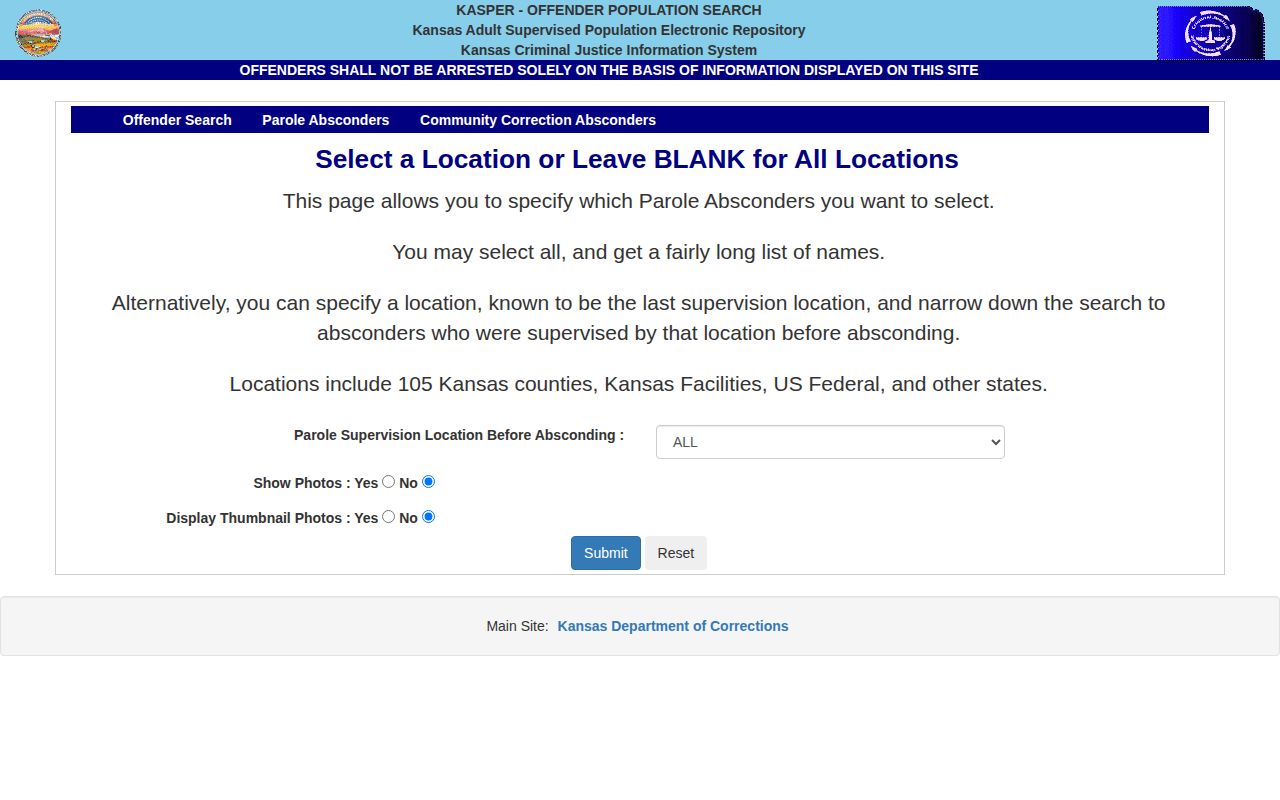
The official warning says the listing is not authority for a private person to make an arrest. Do not approach or attempt to detain someone based on a search result. Information should go to law enforcement or KDOC Enforcement, Apprehension and Investigation at 785-414-7755. Compare identifiers carefully because a place-name filter alone cannot establish identity.
Supervision conditions vary by order and may address reporting, travel, residence, treatment, or other case-specific duties. A violation does not automatically prove revocation or return to prison. Court records can show a probation revocation action, while KDOC movement and status fields can show a state-supervision change. Kansas VINE may provide custody notifications, but it does not replace the supervision order.
How Pratt Supervision Ends
Release from a cell is not the same as discharge from a sentence. KDOC may show a person on parole, conditional release, or postrelease supervision after the prison movement. KASPER can later show “Current Status: Discharged” and a “Date Discharged.” Historical official evidence also uses “Expiration Of Sentence” as a final movement reason. Those fields are stronger evidence of the KDOC endpoint than a missing county-roster name.
Probation ends under the governing court process. The Kansas district-court file may contain an order showing completion, discharge, revocation, or another outcome. Use the Kansas Judicial Branch District Court Records route to reach Case Search, then compare the party, case number, and later orders. For city-ordinance cases, the responsible municipal court may hold the relevant order.
If the practical question is when local custody ended, use the sheriff release record described on the Pratt County released-inmates search page. That record can establish the physical exit time and whether the event was community release or transfer. The court and supervision files explain what obligations continued afterward.
Pratt Interstate Supervision Cases
Kansas participates in interstate supervision for people entering or leaving the state under an approved compact process. In such a case, the Kansas office may be the sending or receiving authority rather than the office nearest the person’s current location. A Pratt address therefore does not, by itself, identify which office controls the case.
Start with the exact KASPER status and parole-office field, then ask the listed office whether interstate compact supervision applies. The sending state may retain legal authority while the receiving state performs day-to-day supervision. Court and KDOC records should control over assumptions based on residence.
Pratt Supervision Record Sources
No single record answers every supervision question. KASPER is strongest for the current KDOC status, parole office, movements, and eventual discharge. The district-court file is strongest for the order that imposed probation, modified conditions, or resolved a violation. The Pratt sheriff’s release record is strongest for the physical jail exit. A VINE event can corroborate a custody change, but it is not the signed order or release sheet.
For a state case, note the KDOC number, conviction county, and case number. Those identifiers separate people with similar names and connect KASPER to the court file. For local probation, begin with the case number and exact wording in the sentencing order. Ask South Central Kansas Community Corrections whether it supervises that order. Its Pratt office does not automatically control every form of probation.
When written proof matters, ask the custodian for an existing document. A useful request names the person and case, identifies the date range, and asks for the status or discharge record maintained. Kansas Open Records Act access can be limited by exemptions, and protected details may be redacted.
Pratt Supervision and New Custody
An alleged violation can lead to a warrant, hearing, arrest, or custody movement, but those steps are not interchangeable. An absconder listing is a reported supervision status. A revocation order is a legal event. A jail roster entry shows a booking. Compare dates and authorities before drawing a conclusion.
If a supervised person appears on the Pratt roster, record the booking number and arresting agency. The booking may arise from a supervision matter, a new charge, or both. The court docket and supervising office can explain the authority, while the jail record shows when that custody period ends. An absence still requires a release-versus-transfer check.
VINE registration can help with a future custody change when the person and agency appear in the system. Follow the live Kansas prompts and keep registration details private. An alert should trigger direct confirmation with the jail or KDOC because notification delivery and agency reporting can lag.
The KBI Registered Offender Search is not a general supervision list. It applies only to people with a statutory registration duty and does not prove parole, probation, or a release date. Use it only when the offense and legal record make that separate duty relevant.
Likewise, a county roster search cannot identify the terms of supervision. It can show a new local booking, subject to update lag, but it does not state which parole or probation condition was involved. Ask the supervising authority for the current official status and use the court file for any filed violation or revocation order.